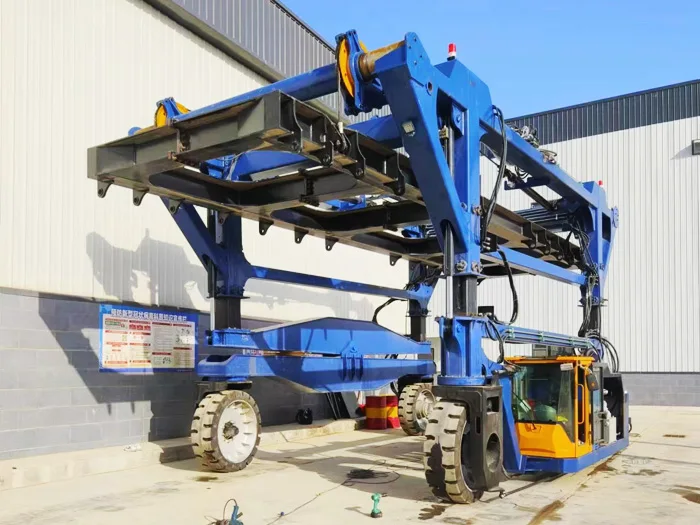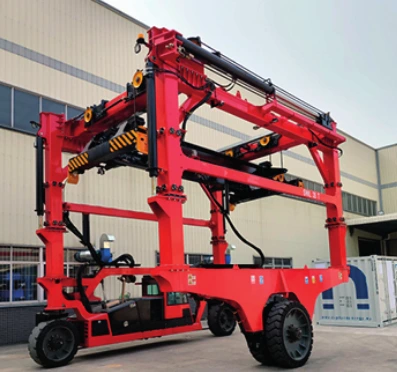
A 35, 60 or 80 ton straddle carrier must fit the complete load, lifting interface and site. The brochure shows differences in overall dimensions, inner width, attachments and electric motor power. A higher capacity does not automatically provide a wider internal opening, greater lift or better access.
Eight model references, compared on the same fields
On a small screen, swipe the table to compare all columns.
| Model | Capacity | Overall L × W × H | Inner width | Secondary lift | Attachment |
|---|---|---|---|---|---|
| SSC35 | 35 t | 6730 × 5300 × 5500 mm | Not listed | 1500 mm | Dedicated device; see SSC35 page |
| HKY3532B5 | 35 t | 9100 × 5100 × 5450 mm | 3200 mm | Not listed | Chain and lock assembly |
| HKY3532A | 35 t | 7100 × 5100 × 6050 mm | 3200 mm | 1550 mm | Automatic spreader |
| HKY6037 | 60 t | 12000 × 5600 × 6400 mm | 3700 mm | 1700 mm | Oversized-load spreader |
| HKY8037 | 80 t | 12000 × 5900 × 6400 mm | 3700 mm | 1700 mm | Oversized-load spreader |
| HKY3532AEV | 35 t | 7100 × 5100 × 6050 mm | 3200 mm | 1550 mm | Automatic spreader |
| HKY6037AEV | 60 t | 12000 × 5600 × 6400 mm | 3700 mm | 1700 mm | Oversized-load spreader |
| HKY8037AEV | 80 t | 12000 × 5900 × 6400 mm | 3700 mm | 1700 mm | Oversized-load spreader |
Sources: SSC35 is on PDF page 2 (printed 02); standard HKY models are on PDF page 3 (printed 03–04); electric AEV models are on PDF page 4 (printed 05). “Not listed” preserves a missing source value. It is not a zero specification.
Open the original Ruiding straddle carrier brochure (PDF page 3). The supplied manufacturer catalogue describes brochure versions; the current offered configuration is confirmed in a project proposal.
What changes between the 35 t arrangements?
SSC35 lists a dedicated lifting-device width and height. HKY3532B5 lists a chain and lock assembly, while HKY3532A and HKY3532AEV list automatic spreaders. B5 is 9100 mm long versus 7100 mm for A and AEV. Those differences change the questions to ask about load engagement, working clearances and operator access.
The SSC35 lifting-device width of 3300 mm must not be compared as if it were the HKY series’ inner-frame width. The catalogue does not provide SSC35 inner width. Request a drawing that defines the actual opening and attachment envelope.
What changes between 60 t and 80 t?
The 60 t HKY6037 and HKY6037AEV versions list 5600 mm overall width; their 80 t counterparts list 5900 mm. All four list 3700 mm inner width, 12000 mm overall length and 6400 mm overall height. The greater external width of the 80 t versions does not establish more internal load clearance.
Both capacities list an oversized-load spreader and 1700 mm secondary lifting height. These entries do not independently confirm container-size coverage, trailer loading or stacking. Those tasks require approved load and working-envelope drawings.
Compare standard and electric versions separately
The AEV models list LFP batteries and permanent magnet synchronous motors: 80 kW for HKY3532AEV, 90 kW for HKY6037AEV and 120 kW for HKY8037AEV. Battery energy and runtime are not stated. Use the electric-carrier guide to prepare the energy and charging brief.
Use a four-step shortlist
- Record the maximum complete lifted mass, centre of gravity and fixture allowances.
- Check the approved lifting points and the attachment’s working range.
- Check inner clearances and the complete loaded travel envelope, including access and turns.
- Review duty, energy supply and acceptance conditions for the offered configuration.
Use the spreader selection guide for attachment questions and the site guide for access and ground information. Ask each quotation to state deviations from the brochure reference.
Questions buyers ask
Can I choose a carrier using the container’s nominal weight?
Use its maximum complete loaded gross mass and approved load distribution, including applicable fixtures. A nominal or empty weight is not a sufficient project basis.
Is an 80 t carrier always larger internally than a 60 t carrier?
No. The reviewed 60 t and 80 t HKY references both list 3700 mm inner width, although their overall widths differ.
Does secondary lifting height equal stacking height?
No. Do not convert that table entry into a stacking claim. Obtain the complete working envelope and project-specific confirmation.
Ask for a model comparison for your load
Send your load drawing, lifting instructions and layout through the project enquiry form. Name the models you are comparing so the proposal can explain configuration differences.