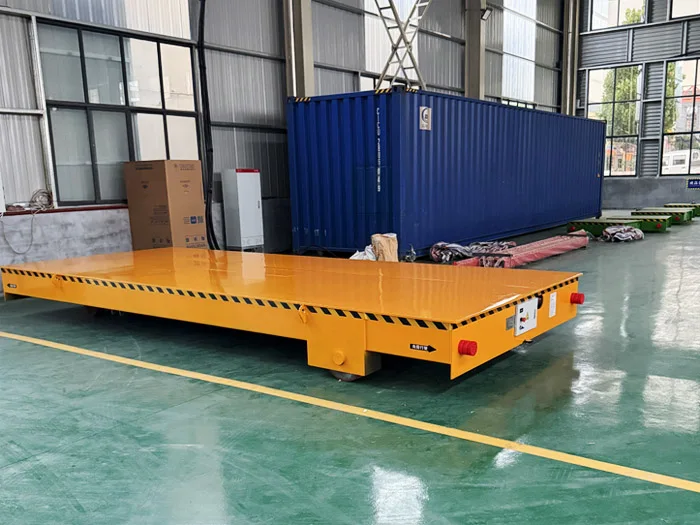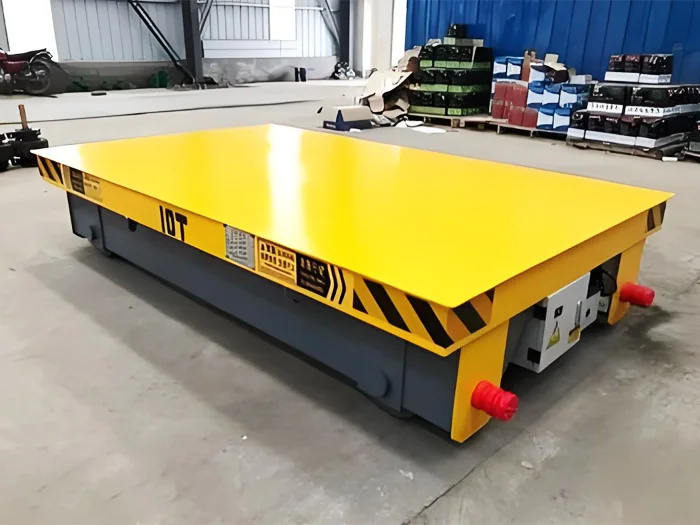
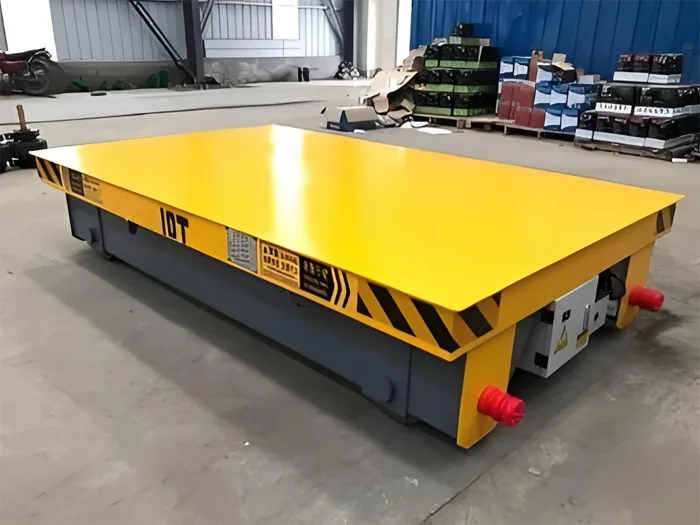
An electric transfer cart is a powered platform used to transport a supported load between work areas. Rail-guided and trackless arrangements serve different route requirements; the choice depends on the layout and operating cycle.
DPW, KPW and KPD transfer series
The AGV catalogue also describes manually operated transfer platforms and rail-powered variants. Power source, travel guidance and automation are separate configuration choices.
Scroll sideways to compare all columns.
| Series | Supply or guidance | What the brochure describes |
|---|---|---|
| DPW | Battery-powered trackless transport | Forward, reverse, sideways travel and rotation; wired and wireless operating methods. |
| KPW | Battery-powered transfer vehicle | DC traction drive with an optional hydraulic lifting arrangement. Confirm route guidance for the quoted design. |
| KPDS | Low-voltage rail supply | Three-rail supply arrangement with onboard voltage transformation. |
| KPDZ | Low-voltage rail supply | Two-rail supply arrangement with optional PLC automation. |
Manufacturer source: Ruiding AGV and transfer cart brochure, PDF pages 6, 7, 8. Brochure values describe the listed versions; confirm the current offered configuration and operating conditions in your quotation.
Where this equipment fits
- Movement of industrial components and assemblies between workstations.
- Transfer of tooling, fixtures and production materials on a suitable support deck.
- Indoor or approved outdoor transport routes with defined floor and access conditions.
Plan the load and the route
A transfer cart transports the load on its deck. Plan how the load is placed on and removed from that deck: an overhead crane, a stationary lifting device or another transfer interface may be required. The supporting frame, load restraint and centre of gravity should be defined before platform dimensions are selected.
Equipment-specific project inputs
| Project input | What to confirm |
|---|---|
| Supported load | Gross mass, centre of gravity, support footprint and any restraint fixture. |
| Platform interface | Deck dimensions and how cranes, stands or stations load and unload the cart. |
| Route arrangement | A fixed rail route or floor travel to several stations; include a layout. |
| Infrastructure | Rail foundations and crossings, or floor loading and turning clearances. |
| Power supply | Confirm battery, cable or another supply for the proposed design and duty. |
| Operator or process control | Manual operating sequence or automation interfaces, as required. |
The table describes information needed for selection. Rated performance and the offered configuration are confirmed in an individual equipment proposal.
Selection questions for this equipment
Is a battery-powered cart always trackless?
No. Power supply and route guidance are separate choices. A battery may supply a rail-guided or trackless design; confirm both for the offered equipment.
Does a transfer cart lift the load onto its deck?
Do not assume lifting from the platform shape. Define the loading and unloading equipment and confirm any lifting function as part of the proposed configuration.
Compare the relevant options
Continue with rail transfer carts, trackless transfer carts, rail vs trackless selection guide.
Prepare your equipment enquiry
Use the RFQ checklist to organise load drawings, route and duty information, then send your project requirements. Read the project FAQs for quotation and service questions.
Company and equipment information is based on Ruiding’s original company website. Project specifications and commercial terms are confirmed in an individual proposal.