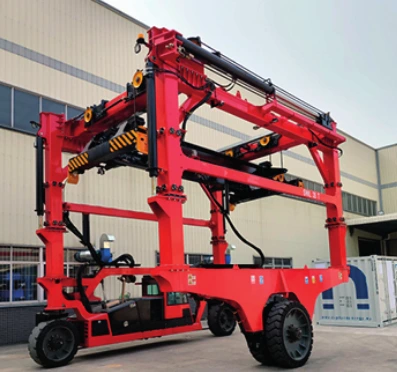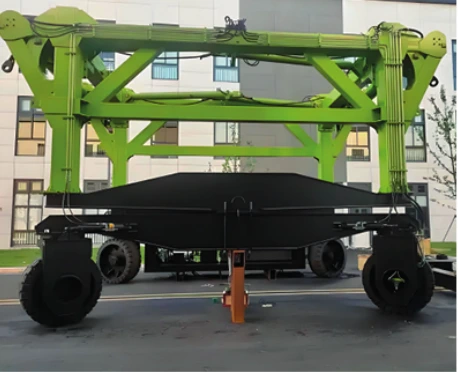
Choose a straddle-carrier lifting attachment from the load’s approved lifting points and handling instructions. Ruiding’s brochure distinguishes a chain and lock assembly, automatic spreaders, oversized-load spreaders and a dedicated SSC35 lifting-device reference. These labels do not by themselves establish compatibility or certification for your load.
The attachment references in the supplied brochure
On a small screen, swipe the table to compare all columns.
| Model reference | Listed attachment | What to investigate |
|---|---|---|
| HKY3532B5 | Chain and lock assembly | 35 t standard reference; secondary lifting height not listed. |
| HKY3532A / HKY3532AEV | Automatic spreader | 35 t references; check lifting-point layout and engagement. |
| HKY6037 / HKY8037 | Oversized-load spreader | 60 / 80 t standard references; require an attachment drawing. |
| HKY6037AEV / HKY8037AEV | Oversized-load spreader | 60 / 80 t electric references; same interface questions still apply. |
| SSC35 | Dedicated lifting-device dimensions | 3300 mm width and 1500 mm height; not an inner-frame-width specification. |
Open the original Ruiding straddle carrier brochure (PDF page 3). The supplied manufacturer catalogue describes brochure versions; the current offered configuration is confirmed in a project proposal.
Start with a load-interface drawing
Mark every approved lifting point with its position, orientation and load limit from the load manufacturer. Include the complete gross mass and centre of gravity, along with prohibited lifting or support surfaces. For cabinets and BESS units, identify whether a frame, skid or temporary fixture stays attached during movement.
A container-shaped enclosure does not establish that its corners can be used in the same way as a conventional freight container. The load supplier’s instructions take precedence over appearance. Send those instructions with the drawing so the carrier and attachment can be reviewed together.
Questions for a chain and lock assembly
- How are chains attached, locked and released at the actual lifting points?
- What attachment geometry and chain angles are permitted for the load?
- Where does the operator stand during engagement and inspection?
- How is an incorrect or incomplete connection identified before lifting?
- What lifting range and placement envelope will the offered arrangement provide?
HKY3532B5’s catalogue description provides a starting point for these questions. It does not supply a numerical secondary lifting height or a complete rigging design. Confirm the attachment, inspection requirements and operating procedure in the proposal.
Questions for automatic and oversized-load spreaders
- Does the proposed spreader fit the lifting-point spacing and orientation?
- How are engagement and release controlled and confirmed?
- What load state, interlock and fault information reaches the operator?
- What is the allowed load distribution and attachment working range?
- How are access, inspection, maintenance and any changeover handled?
“Automatic” describes the source’s attachment label; it is not evidence that the entire transport process is autonomous. “Oversized-load” also needs a dimensional definition. Request drawings that show the proposed attachment with your load at pick-up, travel and placement positions.
Keep attachment and site review connected
An attachment can affect the overall height, lifted mass and operator access. Include it in the loaded site-envelope review. The model comparison helps separate overall dimensions from inner width and lifting-device measurements.
Questions buyers ask
Is an automatic spreader suitable for every 20 ft or 40 ft container?
The supplied source does not establish universal container-size coverage. Confirm the actual corner-fitting layout, mass and proposed spreader range.
Can the lifting attachment be selected after choosing the carrier?
The carrier and attachment should be reviewed together, because interface geometry, attachment mass and working clearances affect the configuration.
Does the brochure prove certification for my lifting task?
No project-specific certification is established by the brochure labels. Request the documentation and validation required for the destination and application.
Send the attachment information with your enquiry
Provide the lifting-point drawing, load instructions, gross mass, centre of gravity and pick-up or placement conditions. Request an attachment and carrier review.