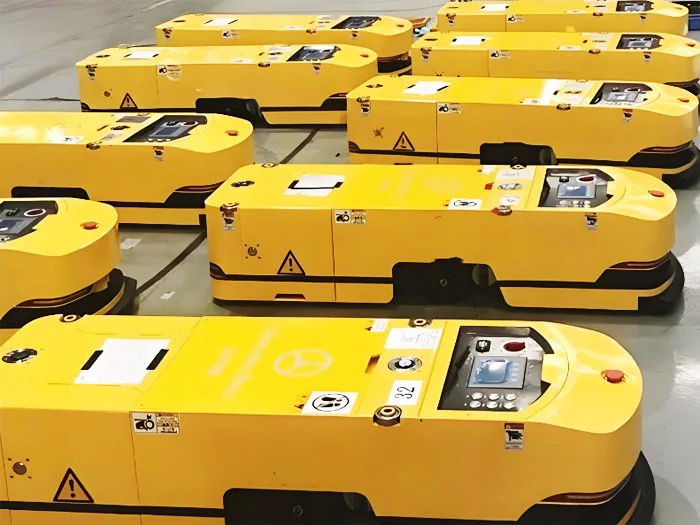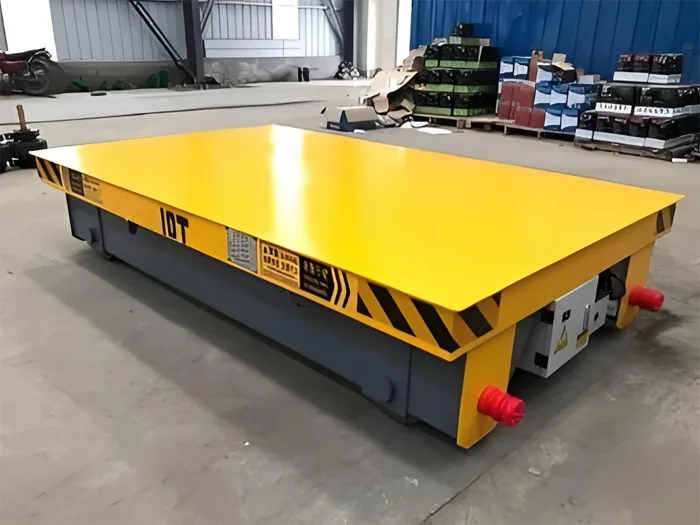
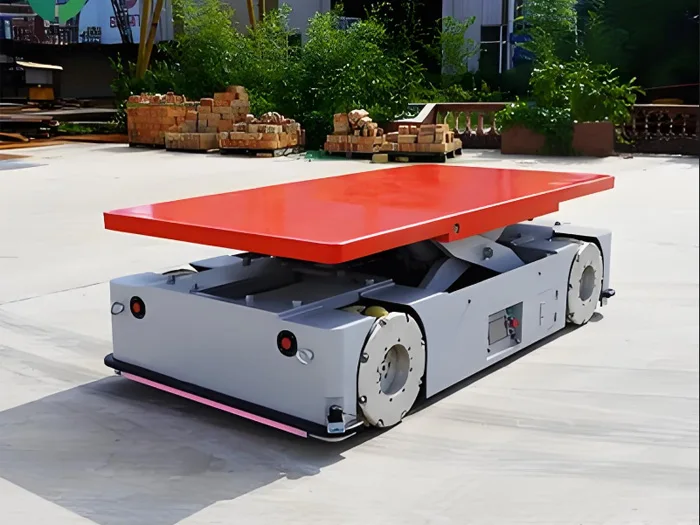
A heavy load AGV, or automated guided vehicle, moves an industrial load along a controlled route. A complete AGV project includes the vehicle, load interface, navigation approach, operating environment and control-system interfaces.
AGV and RGV control architecture
Ruiding’s AGV brochure describes electromagnetic or optical guidance and rechargeable battery power. It also distinguishes rail-guided vehicles (RGVs), whose route is physically guided by rails. The navigation method for the offered vehicle must match the site and docking requirements.
- Vehicle controlsTravel motor, drive and onboard PLC manage movement and exchange operating signals.
- Wireless route networkAccess points distributed along the route carry signals between vehicles and the supervisory system.
- Supervisory PLC and dispatchThe supervisory system processes vehicle status and schedules movement in coordination with plant instructions.
| Component | Function described |
|---|---|
| Integrated drive and steering wheel | Combines drive motor, reducers and steering components. |
| Industrial touchscreen HMI | Displays vehicle state and parameters and provides an operator interface. |
| Lithium battery | Rechargeable onboard energy supply; sizing and charging are project-specific. |
| Ground control cabinet | Includes touchscreen, power indication and main switch with supervisory communication. |
| Route obstacle scanner | Monitors the defined travel area and is described as stopping on detected obstacles or pedestrians. |
| Remote control station | Exchanges wireless commands with the vehicle. |
The control diagram includes MES coordination, dispatch, navigation and drive feedback. Integration protocols, fleet size, docking tolerance, scanner coverage and acceptance tests must be agreed for the actual project. Laser ranging shown as a sensor input does not by itself establish SLAM navigation.
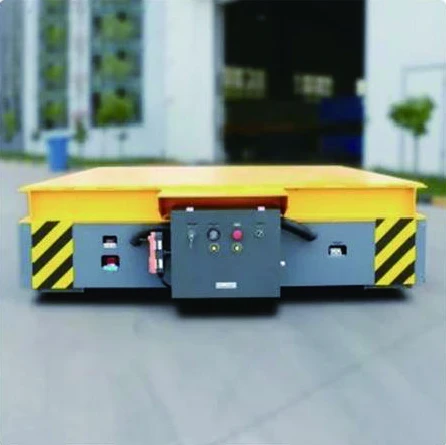
Manufacturer source: Ruiding AGV and transfer cart brochure, PDF pages 3, 4, 5, 6. Brochure values describe the listed versions; confirm the current offered configuration and operating conditions in your quotation.
Where this equipment fits
- Repeated transfers between defined production stations.
- Industrial load movement where docking and cycle repeatability matter.
- Transport automation that must interface with an existing production process.
Plan the load and the route
Automation begins with a stable handling process. Confirm the load’s position and support arrangement at every station, define how a station signals that it is ready, and identify what happens when the route is occupied. Navigation technology, docking accuracy, lifting arrangements and fleet integration must be confirmed for the selected configuration.
Equipment-specific project inputs
| Project input | What to confirm |
|---|---|
| Load handover | Support fixture, pick-up and delivery stations, and loaded centre of gravity. |
| Navigation environment | Route geometry, shared traffic, obstacles and environmental changes. |
| Docking requirement | Positions requiring accuracy, permitted tolerance and verification method. |
| Station signals | Ready, load-present and access signals for every connected process. |
| Operating cycle | Moves per shift, travel distance, dwell periods and charging windows. |
| Acceptance scope | Representative loads, interrupted-cycle recovery and integration responsibilities. |
The table describes information needed for selection. Rated performance and the offered configuration are confirmed in an individual equipment proposal.
Selection questions for this equipment
Which navigation method does this project need?
The choice depends on the operating environment, route changes and positioning requirements. Ruiding must confirm the navigation method and its scope for the proposed vehicle.
How should docking accuracy be specified?
Identify the handover position, permitted tolerance, load condition and measurement method. A general navigation claim does not establish accuracy at every transfer station.
Compare the relevant options
Continue with automated transport planning, AGV project checklist.
Prepare your equipment enquiry
Use the RFQ checklist to organise load drawings, route and duty information, then send your project requirements. Read the project FAQs for quotation and service questions.
Company and equipment information is based on Ruiding’s original company website. Project specifications and commercial terms are confirmed in an individual proposal.