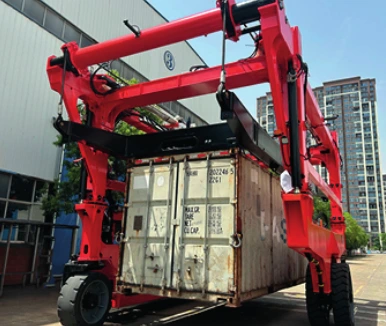
Choose an electric straddle carrier by matching load and lifting geometry first, then specifying the operating cycle, battery energy, charging windows and electrical supply. Ruiding’s brochure lists 35 t, 60 t and 80 t AEV models with LFP batteries and 80, 90 and 120 kW motors. It does not provide battery capacity, charging time or endurance.
What the AEV brochure actually specifies
On a small screen, swipe the table to compare all columns.
| Model | Capacity | Motor power | Overall L × W × H | Attachment |
|---|---|---|---|---|
| HKY3532AEV | 35 t | 80 kW | 7100 × 5100 × 6050 mm | Automatic spreader |
| HKY6037AEV | 60 t | 90 kW | 12000 × 5600 × 6400 mm | Oversized-load spreader |
| HKY8037AEV | 80 t | 120 kW | 12000 × 5900 × 6400 mm | Oversized-load spreader |
Open the original Ruiding straddle carrier brochure (PDF page 4), printed page 05. The supplied manufacturer catalogue describes brochure versions; the current offered configuration is confirmed in a project proposal.
Keep motor power and battery energy separate
Motor power is expressed in kW. Battery energy is specified separately, commonly in kWh, and must be stated for the offered battery pack. An 80 kW motor entry is not an 80 kWh battery specification. Likewise, an LFP chemistry label does not tell you charger power, available operating time or the number of movements per charge.
Ask the supplier to state installed and usable battery energy, operating limits, charger output, charger input requirements and the assumptions behind the proposed charging schedule. Any runtime estimate should use your load and duty, with an agreed reserve and the intended operating conditions.
Describe one complete shift
| Duty input | Information to provide |
|---|---|
| Travel | Loaded and empty distance per movement, route changes and gradients. |
| Lifting | Number of picks and placements, attachment operation and working heights. |
| Waiting | Time at loading positions and whether auxiliary equipment remains active. |
| Charging | Break lengths, between-shift availability and charger location. |
| Environment | Indoor or outdoor use, temperature range and weather exposure. |
| Availability | Required moves per shift and how the process handles a delayed charge. |
Check the charging installation before purchase
Mark the proposed charging position on the site layout and list the available electrical service. Ask for the charger’s supply specification, protection requirements, cable routing and installation scope. Confirm who provides electrical work and what access is needed for routine inspection and maintenance.
Charging can affect the handling process even when it occurs outside normal travel. Define where the carrier waits, whether it obstructs traffic and how an interrupted charge is handled. The supplied catalogue gives no universal charger installation or charging-time commitment.
Compare proposals on the same operating assumptions
- Use the same maximum gross load, lifting interface and route for each proposal.
- Request a duty-based energy and charging statement for the offered configuration.
- List included battery, charger, electrical installation, commissioning and training scope.
- Agree acceptance movements using the representative load and the actual shift pattern.
- Calculate operating cost only after energy use, tariff, maintenance and downtime assumptions are available.
For geometric differences, see the 35 / 60 / 80 t comparison. For site access, use the carrier site-planning checklist.
Questions buyers ask
How long does an AEV straddle carrier run on one charge?
The supplied brochure does not state endurance. Request a calculation using the proposed usable battery energy and your loaded travel, lifting and charging cycle.
Does LFP chemistry establish a charging time?
No. Charging time also depends on the pack, charger, operating limits and starting state of charge. Ask for the offered system’s data.
Which electric model should handle a BESS container?
Start with complete gross mass, geometry, centre of gravity and approved lifting points. Review battery and charging requirements after the mechanical handling fit is established.
Prepare an electric-carrier enquiry
Send the load drawing, route layout, daily movements and available charging windows with your project enquiry. Ask the proposal to identify the battery and charger specification explicitly.