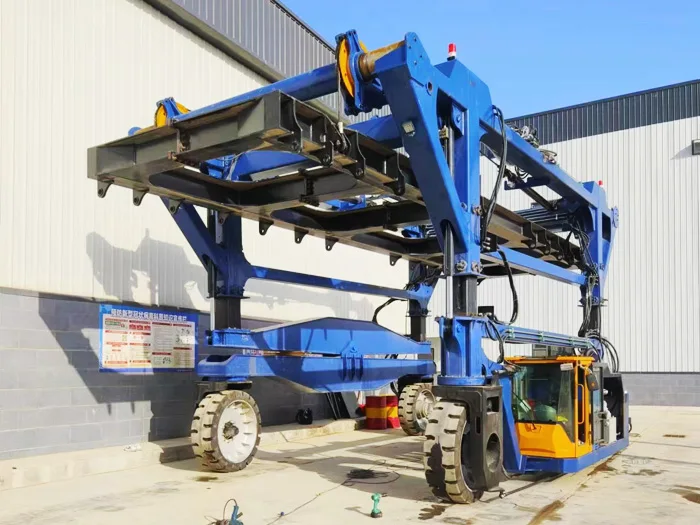
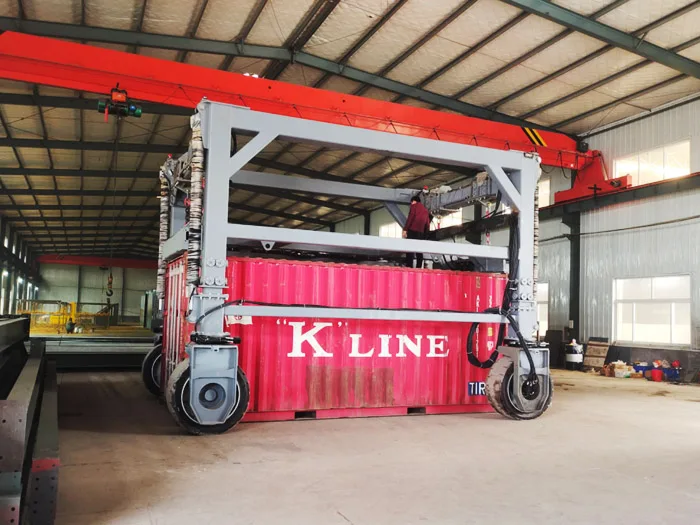
A container straddle carrier lifts and carries a container within a spanning frame. Compatibility depends on the container dimensions, gross mass, lifting interface and the carrier’s approved operating envelope.
Electric container carrier models
The electric series lists 35, 60 and 80 t versions, permanent-magnet synchronous motors and lithium iron phosphate batteries. Battery capacity, charging time and operating duration are not specified in the supplied table and should be requested for the proposed duty cycle.
Scroll sideways to compare all columns.
| Model | Lifting capacity (t) | Overall L × W × H (mm) | Inner width (mm) | Secondary lift (mm) |
|---|---|---|---|---|
| HKY3532AEV | 35 | 7100 × 5100 × 6050 | 3200 | 1550 |
| HKY6037AEV | 60 | 12000 × 5600 × 6400 | 3700 | 1700 |
| HKY8037AEV | 80 | 12000 × 5900 × 6400 | 3700 | 1700 |
Scroll sideways to compare all columns.
| Model | Listed motor power (kW) | Battery chemistry | Lifting attachment |
|---|---|---|---|
| HKY3532AEV | 80 | LFP | Automatic spreader |
| HKY6037AEV | 90 | LFP | Oversized-load spreader |
| HKY8037AEV | 120 | LFP | Oversized-load spreader |
The motor-power field is transcribed from the catalogue; it is not an energy-consumption or battery-capacity figure. Secondary lift is a catalogue mechanism dimension, not a guaranteed stacking height.
Manufacturer source: Ruiding straddle carrier brochure, PDF page 4. Brochure values describe the listed versions; confirm the current offered configuration and operating conditions in your quotation.
For the standard and energy storage versions, compare the HKY3532, HKY6037 and HKY8037 series.
Where this equipment fits
- Moving containers between defined yard or workshop positions.
- Loading and unloading workflows where lifting and transport are combined.
- Industrial container staging with sufficient clearance and suitable ground conditions.
Plan the load and the route
Identify every container size you need to handle and the maximum loaded gross mass. Confirm the lifting interface and corner-fitting arrangement where applicable. Do not assume stacking capability, trailer compatibility or container-size coverage from a photograph; these must appear in the agreed proposal.
Equipment-specific project inputs
| Project input | What to confirm |
|---|---|
| Container type | Actual container dimensions and the maximum loaded gross mass. |
| Pick-up interface | Designated lifting points and the spreader or attachment requirements. |
| Ground and trailer positions | Required pick-up and placement heights, including trailer interfaces. |
| Yard access | Doorways, overhead obstructions and the loaded turning envelope. |
| Container placement | Describe single-level placement or any stacking task explicitly. |
| Route conditions | Surface condition, gradients and ground loading at each handling position. |
The table describes information needed for selection. Rated performance and the offered configuration are confirmed in an individual equipment proposal.
Selection questions for this equipment
Can the carrier stack containers?
Stacking must be a stated requirement with the load and placement height defined. A photograph or the term straddle carrier does not establish stacking capability.
Can it transfer a container to a trailer?
Provide the trailer height, approach layout and container lifting interface. Compatibility depends on the proposed machine and the loaded handling sequence.
Compare the relevant options
Continue with container yard planning, straddle carrier range.
Prepare your equipment enquiry
Use the RFQ checklist to organise load drawings, route and duty information, then send your project requirements. Read the project FAQs for quotation and service questions.
Company and equipment information is based on Ruiding’s original company website. Project specifications and commercial terms are confirmed in an individual proposal.