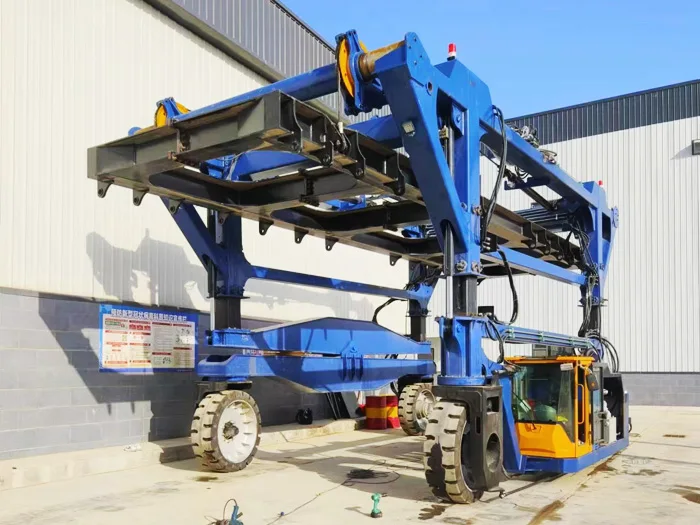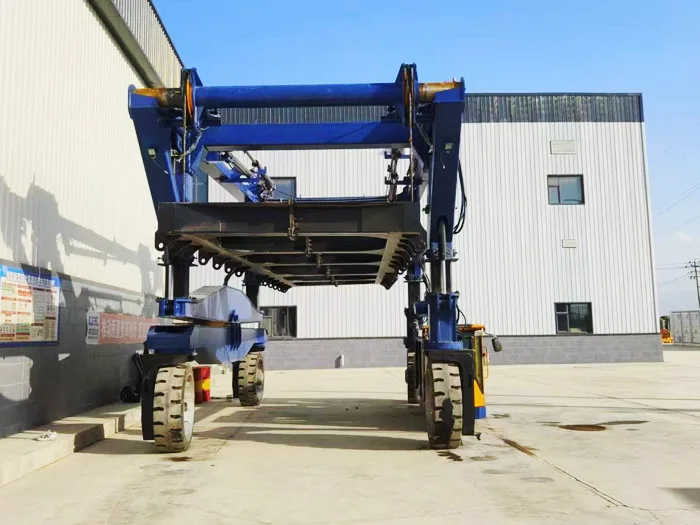
Choose a straddle carrier by matching the complete load, approved lifting points, frame clearance, ground conditions and operating cycle. Confirm every required capability in the equipment proposal; rated payload alone does not establish suitability.
1. Define the entire lifted load
Record the maximum gross mass in the finished condition, including spreaders, fixtures and attached frames. Provide length, width, height and centre of gravity. For a container, identify the dimensions and permitted lifting points. For a cabinet or fabricated structure, obtain a lifting drawing from the load supplier.
2. Confirm the lifting interface
Describe how the load may be picked up and where force may be applied. A container interface and a cabinet lifting frame are different requirements. Clarify the available lift height, required clearance and the sequence for picking up and placing the load. Do not infer the supplied lifting arrangement from a general product image.
3. Map the loaded route
- Identify pick-up and placement positions, including any trailer interfaces.
- Measure aisle widths, gateways, overhead clearances and turning areas.
- Assess ground bearing capacity, surface irregularities and gradients.
- Identify interactions with other vehicles and pedestrians.
4. Describe the working cycle
State moves per hour or shift, distances, dwell times and available charging or refuelling windows. Clarify whether the carrier works indoors, outdoors or across both environments. Include ambient and site conditions that affect the required configuration.
5. Compare proposals on the same basis
| Project input | What to define |
|---|---|
| Capacity and geometry | Agreed load envelope, gross mass and lifting arrangement. |
| Operating route | Permitted surface, gradient, turning envelope and travel limits. |
| Functional scope | Required lifting, travel, steering and control features. |
| Verification | Acceptance loads, operating sequence and performance checks. |
| Commercial scope | Documentation, delivery, installation, training and service terms. |
Straddle carrier vs transfer cart
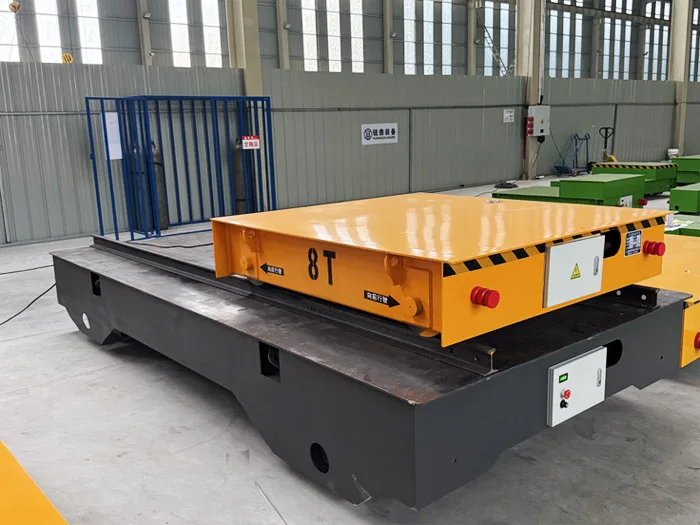
Choose by how the load is picked up and supported throughout the movement. Payload alone does not identify the appropriate equipment.
| Decision | Straddle carrier | Transfer cart |
|---|---|---|
| Load support | Spans the load and uses an approved lifting interface. | Carries a supported load on a platform or fixture. |
| Loading and unloading | The offered carrier must suit the load’s pick-up points and required placement height. | Define an external loading interface or confirm any lifting function included in the proposed cart. |
| Route planning | Review frame clearances, ground conditions and the loaded turning path. | Review the rail layout or floor route, deck handover and loaded turning space. |
| Starting question | Does the task require lifting and carrying the unit within a spanning frame? | Can the unit be placed and secured on a deck at every transfer station? |
Review the straddle carrier range and electric transfer cart range using the same load and operating-site drawings.
Questions to ask before purchase
Does a straddle carrier need installed rails?
A straddle carrier commonly uses a mobile wheel arrangement, but equipment suitability still depends on the ground and site. Confirm the proposed machine and its route requirements.
Can every straddle carrier stack containers?
No universal stacking capability should be assumed. Required placement height and stacking tasks must be included in the project brief and confirmed for the proposed design.
Is a BESS container handled like a freight container?
Use the energy storage supplier’s handling instructions. Internal components and mass distribution may introduce additional lifting or movement requirements.
Explore Ruiding straddle carriers or prepare an enquiry with our RFQ checklist.
Read a model table against the load drawing
Ruiding’s supplied brochure now provides eight identifiable 35, 60 and 80 t versions. Compare overall dimensions, inner width where listed, secondary lift and attachment type. Overall machine dimensions are not the usable load envelope, and secondary lift is not a stacking-height rating. Ask for a dimensioned configuration drawing before selecting the model.