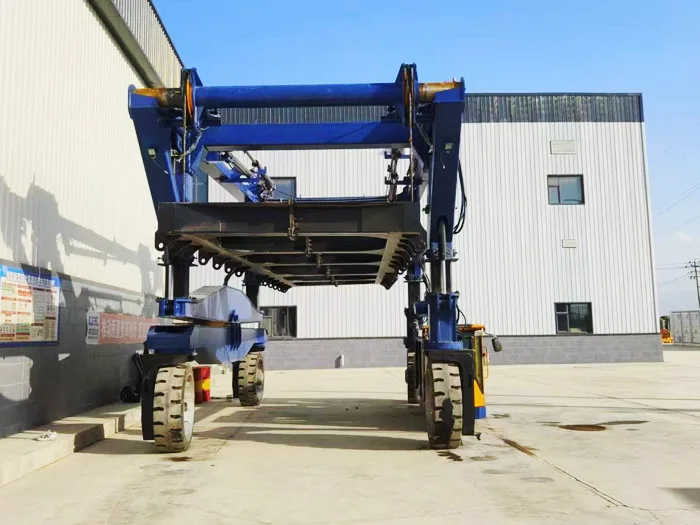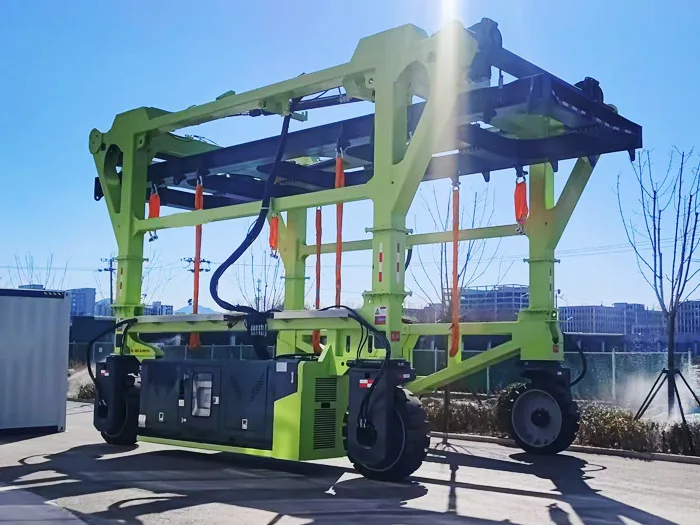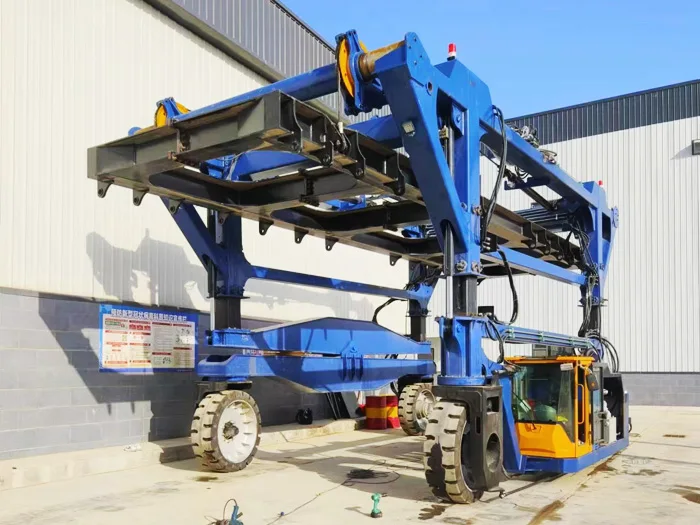
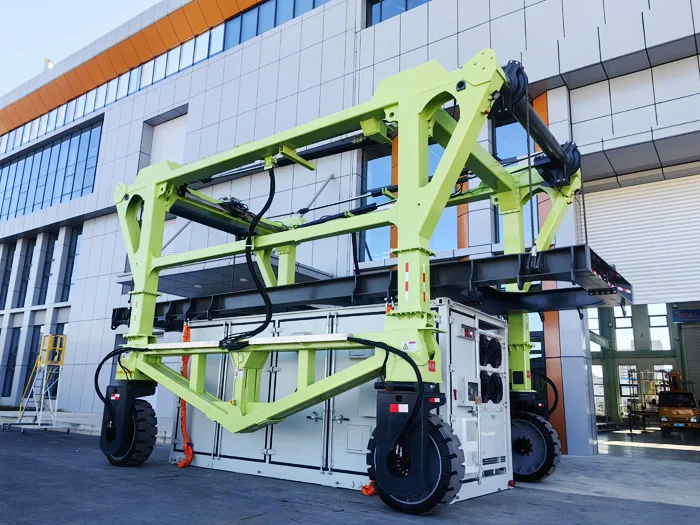
An energy storage cabinet carrier uses a straddle-type frame to lift and transport a cabinet or suitable framed unit. The lifting arrangement must be approved for the cabinet rather than inferred from container handling practices.
SSC35 energy storage carrier
The catalogue identifies SSC35 as an energy storage straddle carrier with a 35 t lifting-capacity entry. It may be evaluated for suitable cabinet or framed-unit tasks after checking the approved handling interface; it is not a universal cabinet compatibility claim.
| Parameter | Listed value |
|---|---|
| Model | SSC35 |
| Lifting capacity | 35 t |
| Overall dimensions (L × W × H) | 6730 × 5300 × 5500 mm |
| Secondary lifting height | 1500 mm |
| Minimum ground clearance | 200 mm |
| Lifting-device dimensions | Width 3300 mm; height 1500 mm |
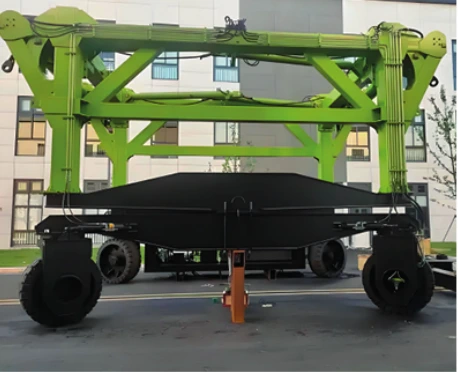
Manufacturer source: Ruiding straddle carrier brochure, PDF page 2. Brochure values describe the listed versions; confirm the current offered configuration and operating conditions in your quotation.
Lifting-device dimensions do not define the permissible cabinet envelope by themselves. Send the cabinet drawing and the complete lifting or support-frame arrangement for review.
Where this equipment fits
- Movement of assembled energy storage cabinets between defined locations.
- Production-to-staging transfer with a suitable lifting frame.
- Handling routes where cabinet clearance and positioning require particular attention.
Plan the load and the route
Cabinet handling differs from full container handling. Specify whether the cabinet can be lifted directly, requires a dedicated frame, or should remain supported on a pallet or skid. Include the finished mass, lifting-point drawing, allowable orientation and any required protective clearances. Confirm the carrier-to-load interface before ordering equipment.
Equipment-specific project inputs
| Project input | What to confirm |
|---|---|
| Cabinet assembly | Finished mass, overall dimensions and fitted accessories. |
| Permitted support | Direct lifting points, a dedicated frame, pallet or skid as specified by the cabinet supplier. |
| Stability and orientation | Centre of gravity, permitted orientation and restraint requirements. |
| Interface clearances | Access around cabinet doors, connections and protective fixtures. |
| Placement positions | Pick-up and destination heights and the available positioning space. |
| Loaded route | Floor conditions, doorways and clearances for the cabinet and its handling frame. |
The table describes information needed for selection. Rated performance and the offered configuration are confirmed in an individual equipment proposal.
Selection questions for this equipment
Can the cabinet be lifted like a freight container?
Do not assume a shared lifting interface. Use the cabinet supplier’s designated lifting points or approved frame, pallet or skid arrangement.
What clearance matters around a finished cabinet?
Include doors, connections, accessories and protective fixtures in the load envelope. Confirm the access required during pick-up, travel and placement.
Compare the relevant options
Continue with BESS container carriers, energy storage handling workflow.
Prepare your equipment enquiry
Use the RFQ checklist to organise load drawings, route and duty information, then send your project requirements. Read the project FAQs for quotation and service questions.
Company and equipment information is based on Ruiding’s original company website. Project specifications and commercial terms are confirmed in an individual proposal.