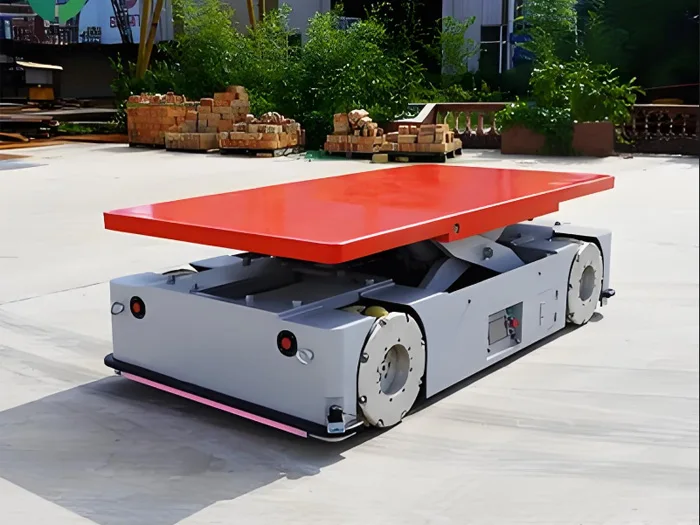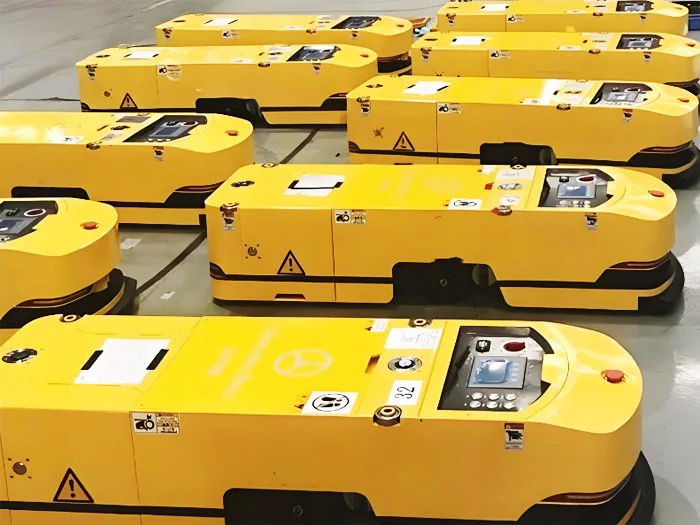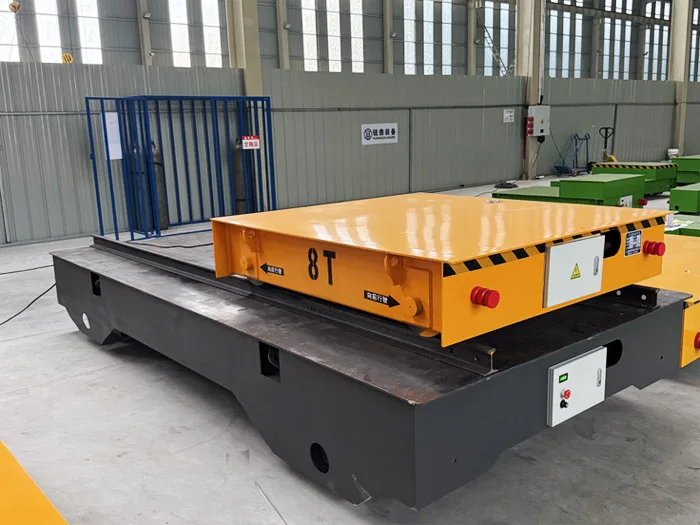
A useful heavy load AGV brief defines the complete supported load, transfer stations, route, positioning requirement, control interfaces and operating cycle. Vehicle capacity is one input; process integration determines whether the transport task can be automated reliably.
Describe the load at every station
Record the maximum loaded mass, dimensions, centre of gravity and any support fixture. Explain whether the vehicle carries a pallet, passes under a stand, receives a load from a crane or transfers to a conveyor. Provide drawings for every handover location.
Map the route and its interruptions
- Travel distance, route widths, intersections and stopping positions.
- Doors, lifts and changes in floor level that need coordinated control.
- Shared areas with pedestrians or other vehicles.
- Temporary obstacles and the expected recovery procedure.
- Charging position and available charging windows.
Agree navigation and positioning requirements
State where positioning accuracy matters and how it will be measured. Navigation type and docking precision are equipment-specific requirements that must be confirmed in the proposal. Do not transfer performance figures from a different manufacturer or model to the selected vehicle.
Define production interfaces
| Project input | What to define |
|---|---|
| Station readiness | How a station confirms that it can receive or release the load. |
| Load confirmation | How the process confirms that the load is present and correctly positioned. |
| Access control | How doors, barriers or other controlled equipment interact with the vehicle. |
| System connection | Required communication with plant software or machine controls. |
| Fault recovery | Who clears faults and how interrupted cycles are restarted. |
Set project acceptance criteria
Agree tests for the representative maximum load, route, shift pattern and docking conditions. Define expected behaviour when a route is occupied or a station is not ready. Safety functions and a site-specific risk assessment should be reviewed by competent parties as part of the project.
Prepare the commercial scope
Clarify who provides loading fixtures, control interfaces, installation, training, documentation and service. Confirm delivery and commissioning arrangements for the project country. A clear division of responsibilities helps avoid gaps between the vehicle and the surrounding production equipment.
See Ruiding heavy load AGVs and automated transport application planning.
Questions prompted by Ruiding’s brochure
- Which electromagnetic, optical or rail-guided approach is included in the offered design?
- Who supplies and surveys the route wireless access points?
- What signals pass between the onboard PLC, supervisory PLC and plant systems?
- What operating states and controls are shown on the HMI?
- How are scanner fields, station access and interrupted cycles tested on the real site?
Manufacturer source: Ruiding AGV and transfer cart brochure, PDF pages 3, 4, 5, 6. Brochure values describe the listed versions; confirm the current offered configuration and operating conditions in your quotation.