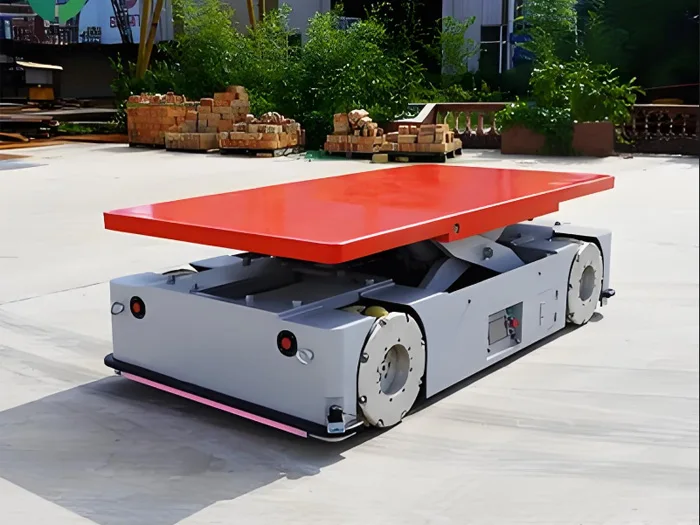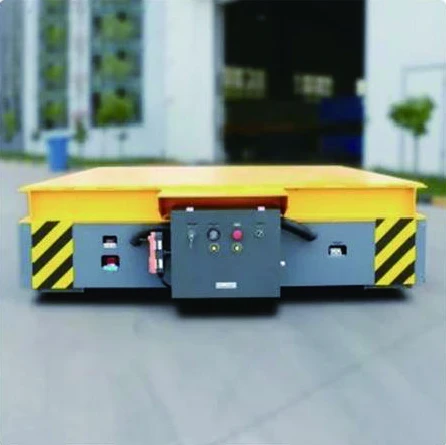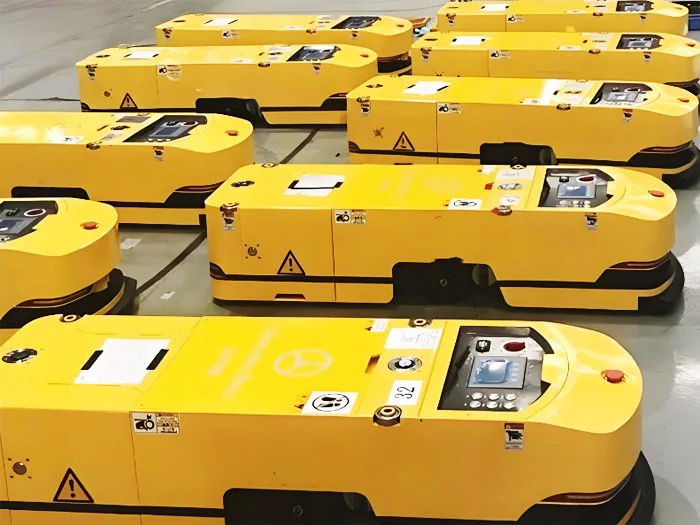
A heavy load AGV site survey should document the load, route, floor, station geometry, wireless coverage and surrounding traffic. Use measured drawings and process states to define the vehicle and controls. The survey is an input to design and acceptance, not proof that a generic AGV configuration fits the site.
Create a marked-up route plan
Plot every pick-up and drop-off station, the loaded and empty routes, passing areas, doors, intersections and charging location. Mark where the vehicle turns, reverses, waits or shares space with pedestrians and other transport equipment. Record temporary obstructions such as pallets and production queues.
Include the complete load and fixture outline. An empty vehicle footprint does not describe the occupied envelope when carrying a long component or an offset load. Supply the load mass, centre of gravity, support points and any orientation limits at each station.
Record the floor and physical constraints
| Survey area | What to record |
|---|---|
| Floor structure | Available slab or floor documentation; request the proposed wheel reactions. |
| Surface condition | Joints, cracks, covers, contamination and uneven areas. |
| Route geometry | Clear openings, turns, slopes, crossfall and transitions. |
| Station approach | Approach direction, space to align and nearby fixed equipment. |
| Environment | Lighting, dust, moisture and indoor or outdoor exposure relevant to the selected system. |
| Shared areas | Pedestrians, forklifts, doors and intersections; operating restrictions and ownership. |
Confirm the proposed navigation method before deciding which route features need particular measurement. The brochure discusses electromagnetic or optical guidance and an RGV rail-guided reference; it does not establish the navigation technology or accuracy for every offered vehicle. Ask for the selected system’s requirements.
Define station datums and transfer conditions
For each station, mark the mechanical reference or docking datum and the acceptable load-transfer position. Define pick-up and release heights, supporting fixtures, load restraints and the equipment responsible for moving the load onto or off the vehicle. Record how a station confirms it is clear, ready and finished.
Do not specify docking accuracy as a single number detached from the transfer process. Ask how the proposed arrangement will be measured under representative load and floor conditions, and what alignment devices or fixture tolerances are included. The supplied brochure contains no project-specific numerical docking tolerance.
Survey wireless coverage with the operating route in mind
The manufacturer’s control description uses APs along the route for signal transmission. Mark planned AP locations, obstructions, existing network equipment and where ownership changes between plant IT and the equipment supplier. Test the route under representative operating conditions rather than relying only on a static office coverage map.
Agree coverage and handover requirements, network access responsibilities and the vehicle’s response to communication loss. Large loads, doors and changing storage positions should be included in the site discussion. Use the control-system guide to define the related status and recovery requirements.
Use one survey pack for quotation and acceptance
- Scaled route layout, station drawings and measured restrictions.
- Load and fixture drawings, maximum gross mass and centre of gravity.
- Floor information and the list of joints, ramps, covers and transitions.
- Wireless survey inputs, network ownership and plant-interface documents.
- Station handshakes, traffic rules and recovery responsibilities.
- Representative acceptance loads, routes, transfer cycles and agreed abnormal scenarios.
The general AGV project checklist covers wider commercial scope and acceptance responsibilities. This site survey concentrates on measured route and station inputs so different suppliers can respond to the same environment.
Open the original Ruiding AGV and transfer cart brochure (PDF page 4), printed page 05–06. The supplied manufacturer catalogue describes brochure versions; the current offered configuration is confirmed in a project proposal.
The brochure’s network topology and component descriptions continue on PDF pages 5–6. Project-specific payload, docking tolerance, wireless criteria and navigation selection must be confirmed separately.
Questions buyers ask
Can the site survey prove that our floor supports the AGV?
The survey collects the available structure and route data. Obtain proposed wheel reactions and have the relevant structure assessed for the actual operating conditions.
What docking accuracy should we request?
Start with the station transfer tolerance and fixture geometry, then ask the supplier to define and verify the proposed arrangement. No universal tolerance is established by the supplied brochure.
Do we need a wireless survey for a single AGV?
If the selected control arrangement depends on route wireless communication, define and verify its coverage and communication-loss behaviour for the project. Vehicle count alone does not establish network suitability.
Request a site and station review
Send the layout and load information through the project enquiry form. Identify any route, floor, docking or network data still to be measured.