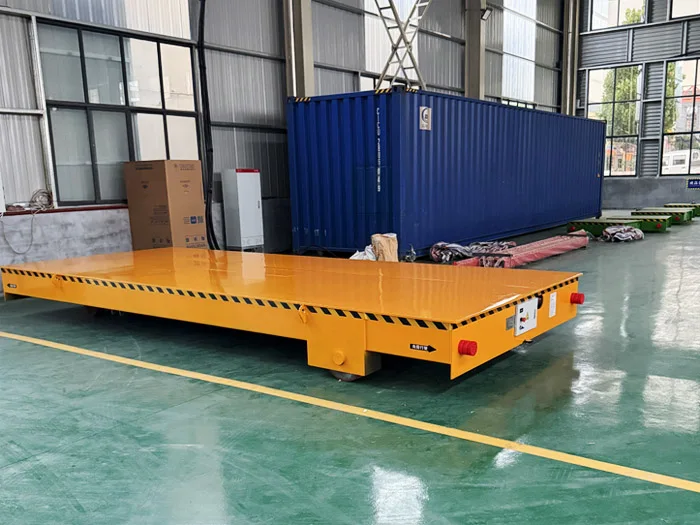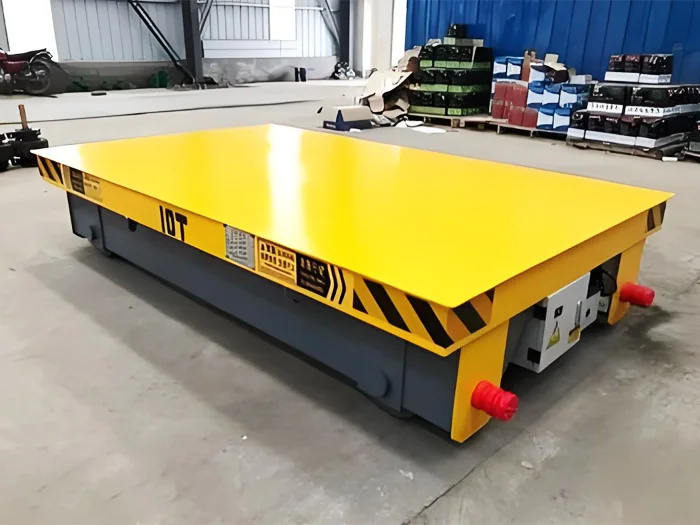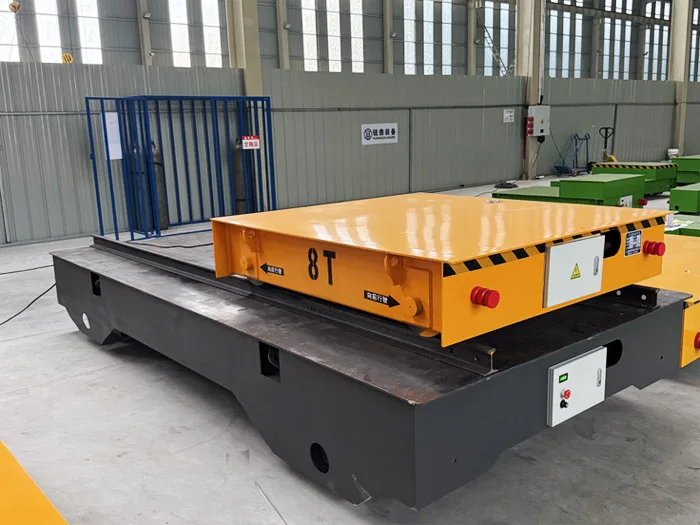
A rail transfer cart follows an installed track and suits a defined transport line. A trackless transfer cart travels on a suitable floor and may serve flexible routes. Select between them by reviewing the route, floor or foundation, turning space and load interfaces.
Compare the operating requirements
| Decision | Rail-guided cart | Trackless cart |
|---|---|---|
| Route | Guided by installed rails; route changes require rail-layout review. | Selected floor route; assess steering and loaded turning space. |
| Infrastructure | Track, foundation and crossings must suit the cart and load. | Floor loading, gradients, joints and access must suit the proposed vehicle. |
| Load handover | Coordinate deck and fixture with the station layout. | Coordinate deck and fixture at every served location. |
| Power and control | Confirm supply and control method for the offered design. | Confirm energy storage, charging and operator controls. |
| Automation | A fixed route does not by itself make the system automatic. | A trackless vehicle is not necessarily an AGV. |
When a rail-guided cart is worth evaluating
Consider rails when the handling process follows the same defined route between fixed stations and the facility can accommodate the required track and foundation. Assess crossings, available maintenance access and any changes in floor elevation. The rail layout is part of the equipment scope, not a separate afterthought.
When a trackless cart is worth evaluating
Consider a trackless arrangement when loads need to travel to different locations or the production layout does not favour a fixed track. Confirm the travel surface, floor point loading and steering envelope with the actual load. Ask the supplier to state the allowable route conditions for the proposed configuration.
Check the loading and unloading process
Both arrangements carry a supported load on a deck. Define how the load reaches the platform, how it is restrained and how it leaves at the destination. An overhead crane, lifting station, transfer stand or other interface may be needed. Platform length and width should reflect the fixture and load envelope.
Questions that clarify the choice
- Is the transport path fixed for the life of the process?
- Can the site support installed rails and suitable foundations?
- Does the floor support the proposed wheel loads?
- Is there enough space to turn with the complete load?
- How often will the route or production layout change?
What to send for a quotation
Provide a plan view of the route, maximum load and fixture dimensions, loading method, shift pattern and project location. Compare rail transfer carts and trackless transfer carts using the same assumptions.
Manufacturer series to compare
DPW describes trackless battery transport; KPW describes a battery-powered transfer platform; KPDS and KPDZ describe rail-supply arrangements. These series descriptions help frame a quotation, but do not make guidance, automation or hydraulic lifting interchangeable.
Review the brochure series comparison and download the source catalogue.