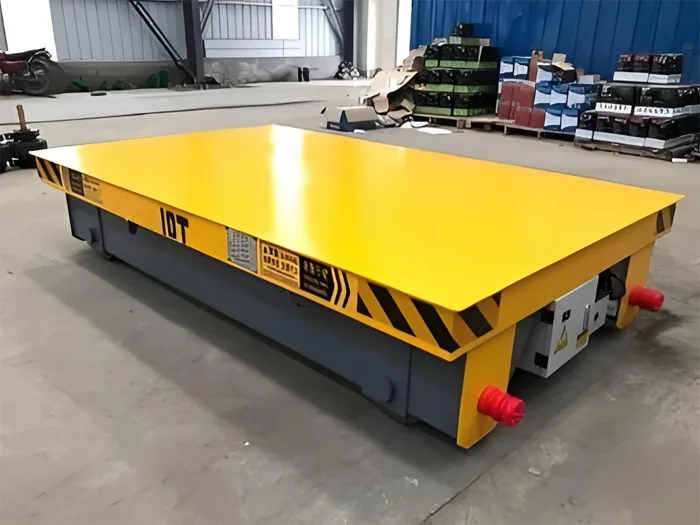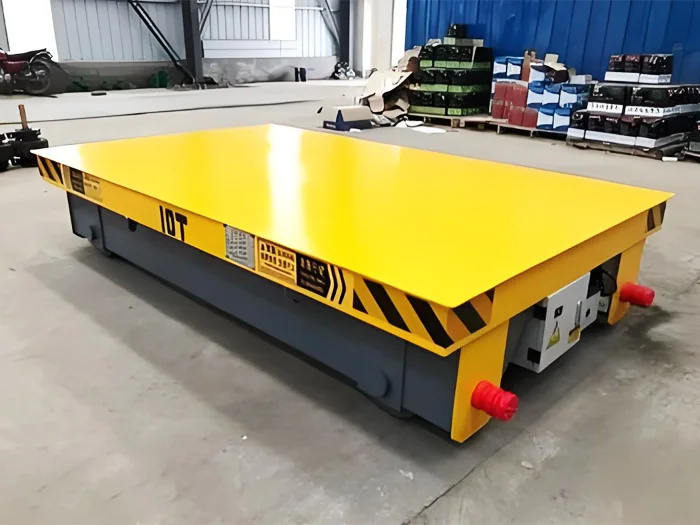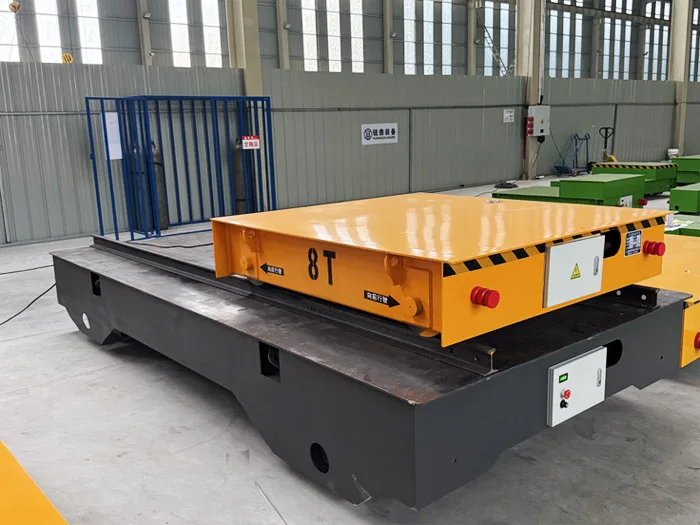
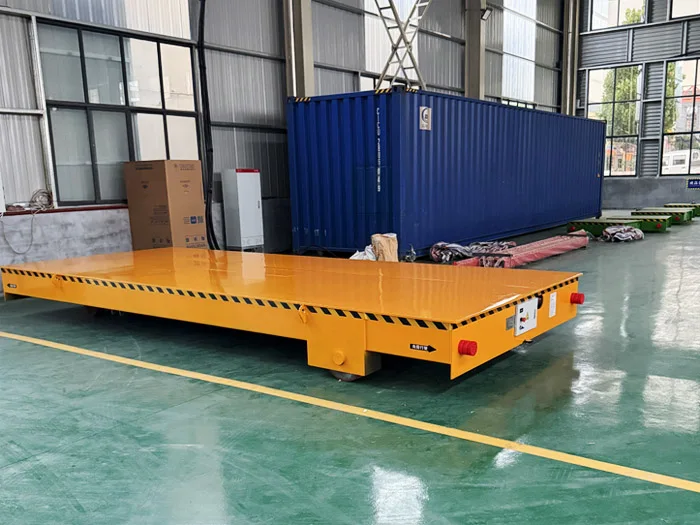
A rail-guided transfer cart runs on an installed track and carries the load on its deck. The track guides the route, so the cart and rail layout must be engineered as one handling arrangement.
KPDS and KPDZ rail-powered series
The KPD family is described as a low-voltage rail-powered transfer arrangement. The brochure lists a 380 V AC site supply stepped down to 36 V AC at the rails, with different vehicle-side arrangements for the two series.
Scroll sideways to compare all columns.
| Series | Rail supply arrangement | Design considerations |
|---|---|---|
| KPDS | Three rails at 36 V AC; onboard transformer raises the supply to 380 V for the drive. | Insulated rails and supply design; brochure calls for extra transformers beyond 70 m to address voltage drop. |
| KPDZ | Two rails at 36 V AC feeding the vehicle electrical system. | Insulated rails and optional PLC controls; brochure calls for extra transformers beyond 80 m to address voltage drop. |
These distances describe the brochure’s supply arrangements, not universal maximum travel distances. Transformer spacing, electrical protection, site voltage and installation requirements must be engineered for the actual route. A rail supply value is not proof of destination electrical compliance.
Manufacturer source: Ruiding AGV and transfer cart brochure, PDF page 8. Brochure values describe the listed versions; confirm the current offered configuration and operating conditions in your quotation.
Where this equipment fits
- Repeated transport between work areas connected by a defined track.
- Industrial production layouts where a fixed route suits the process.
- Heavy assemblies supported on a project-specific deck or fixture.
Plan the load and the route
Map the complete route, including crossings, changes in elevation and any transfer between existing rails. Define track gauge, wheel interface and the condition of existing foundations where relevant. Power supply and control methods vary by configuration and should be confirmed rather than assumed from the general electric-cart category.
Equipment-specific project inputs
| Project input | What to confirm |
|---|---|
| Rail layout | Track gauge, total route, crossings and any curves or elevation changes. |
| Existing foundation | Condition and loading information for rails and foundations already installed. |
| Deck and fixture | Supported load, platform dimensions and restraint arrangement. |
| Station handover | Loading equipment, deck height and coordination at fixed stations. |
| Electrical supply | Proposed supply method, available site voltage and the full operating cycle. |
| Operating sequence | Operator controls, stopping positions and any agreed automation interfaces. |
The table describes information needed for selection. Rated performance and the offered configuration are confirmed in an individual equipment proposal.
Selection questions for this equipment
Does running on rails make a cart automatic?
Rails guide movement. Automated cycles, station signals and stopping controls must be defined and confirmed separately.
Can an existing track be reused?
Provide the gauge, geometry, condition and foundation information. Compatibility requires review of the proposed cart and the complete loaded condition.
Compare the relevant options
Continue with trackless alternatives, rail vs trackless comparison.
Prepare your equipment enquiry
Use the RFQ checklist to organise load drawings, route and duty information, then send your project requirements. Read the project FAQs for quotation and service questions.
Company and equipment information is based on Ruiding’s original company website. Project specifications and commercial terms are confirmed in an individual proposal.