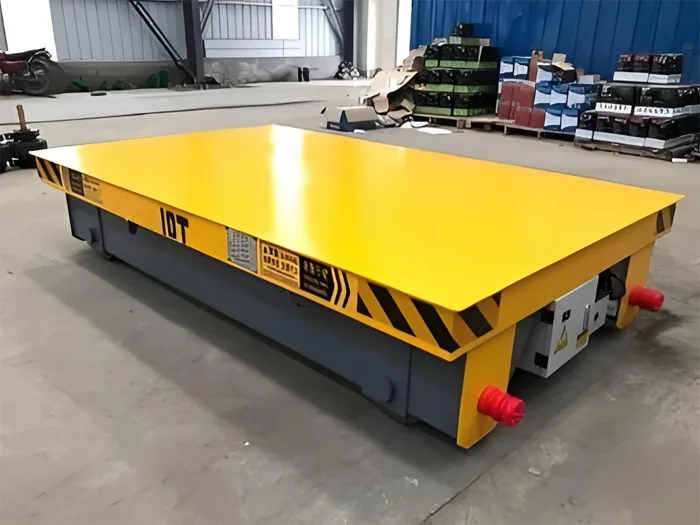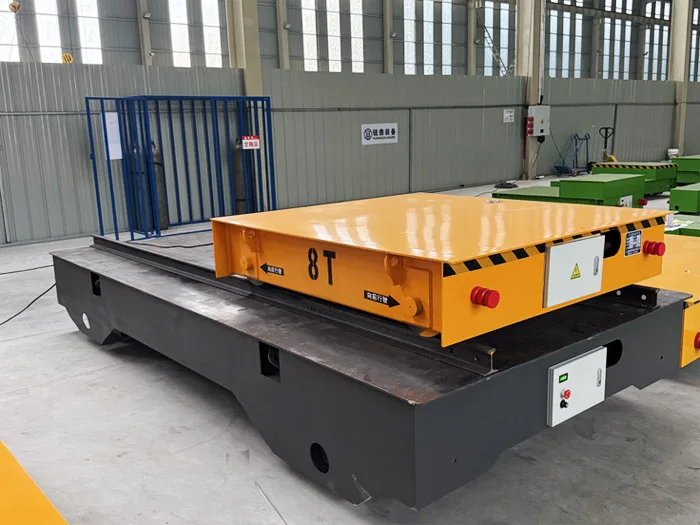
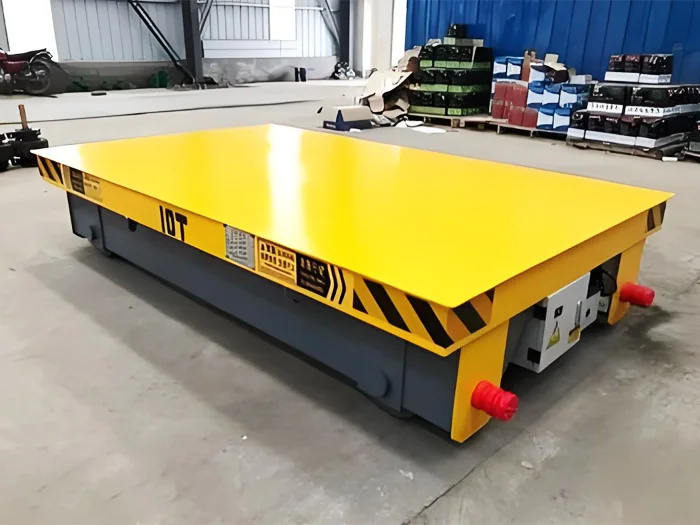
A trackless transfer cart moves on a suitable floor without an installed guide rail. Its usable route depends on floor conditions, steering space, load stability and the approved machine configuration.
DPW trackless transfer configuration
Ruiding’s DPW description includes battery power, forward and reverse movement, sideways travel, turning and 360° rotation, together with wired and wireless operating methods. These are catalogue-described functions; confirm the motion modes included in the specific proposal.
- Define the loaded aisle width and steering envelope for each movement.
- Specify whether hydraulic lifting is required and agree its interface and stroke.
- Review speed control, emergency stop, warning lights and route interactions as part of the configuration.
- Match battery duty and charging windows to the operating cycle.
KPW is also described as a battery-powered transfer series, with DC traction and optional hydraulic lifting. The catalogue does not provide an unambiguous model-by-model route or payload table for KPW; confirm those fields before comparison.
Manufacturer source: Ruiding AGV and transfer cart brochure, PDF pages 6, 7. Brochure values describe the listed versions; confirm the current offered configuration and operating conditions in your quotation.
Where this equipment fits
- Factory transfers between multiple workstations.
- Layout-dependent movement where a fixed track is not preferred.
- Supported industrial loads with a suitable loading and unloading arrangement.
Plan the load and the route
Measure the narrowest aisle and doorway, then evaluate the turning envelope with the actual load. Floor point loading, gradients and joints can determine whether a route is suitable. Clarify the required steering modes, operator controls and charging arrangement. Trackless does not automatically mean autonomous: operator-driven and guided transport are different project scopes.
Equipment-specific project inputs
| Project input | What to confirm |
|---|---|
| Loaded turning envelope | The complete load and fixture, narrowest aisle and each turn on the route. |
| Floor loading | Surface condition, available floor-bearing data and concentrated wheel loads to be reviewed. |
| Route interruptions | Joints, gradients, obstructions and crossings along each proposed path. |
| Deck handover | Load support, restraint and loading or unloading equipment at each station. |
| Steering and controls | Required movements and operator control; automated guidance is a separate requirement. |
| Energy replenishment | Duty cycle, travel distance and practical charging windows for the offered cart. |
The table describes information needed for selection. Rated performance and the offered configuration are confirmed in an individual equipment proposal.
Selection questions for this equipment
Is a trackless cart the same as an AGV?
No. Trackless describes floor travel without installed rails. Automated navigation and process integration are separate capabilities that must be specified.
How much turning space is required?
The answer depends on steering, platform and load geometry. Submit the route layout and confirm the loaded turning envelope for the offered configuration.
Compare the relevant options
Continue with rail-guided alternatives, automated guided transport.
Prepare your equipment enquiry
Use the RFQ checklist to organise load drawings, route and duty information, then send your project requirements. Read the project FAQs for quotation and service questions.
Company and equipment information is based on Ruiding’s original company website. Project specifications and commercial terms are confirmed in an individual proposal.