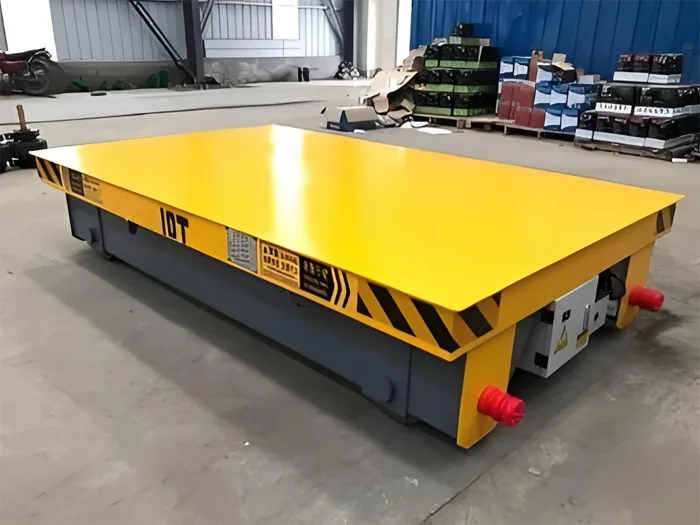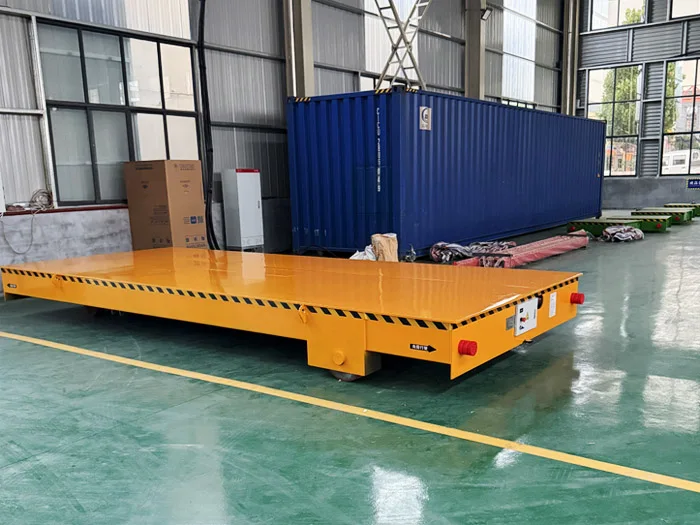
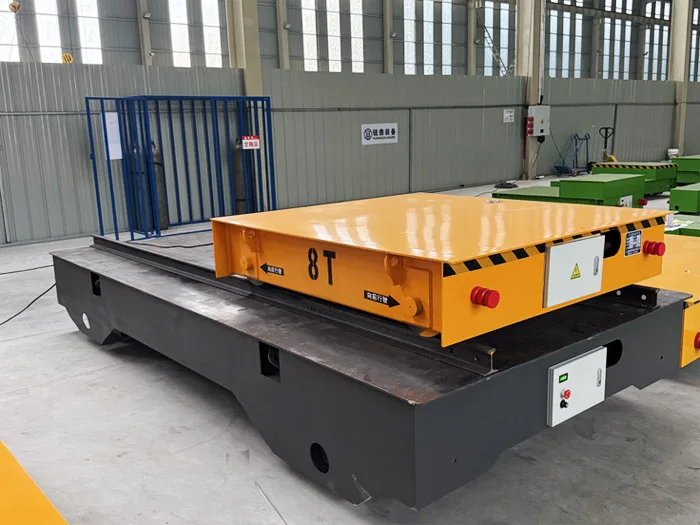
Connect production work areas with a transfer platform matched to your load support and route.
Match the supply arrangement to the factory route
The manufacturer’s brochure describes DPW trackless transport, KPW battery-powered vehicles and KPDS/KPDZ rail-powered carts. Describe whether the route needs flexible floor travel or fixed rail guidance, how the platform is loaded and how many moves the shift requires.
Start with the handling task
A successful factory transfer route includes more than the journey between stations. The load must be safely placed on the platform, supported during movement and unloaded at the destination. Coordinate the cart deck, fixtures and surrounding equipment as one operating process.
What your project brief should include
- Load mass, footprint, centre of gravity and fixture arrangement.
- Available cranes or other loading and unloading devices.
- Fixed rail route or flexible floor route.
- Door widths, crossing points, gradients and floor loading.
- Required transfer frequency, operator controls and charging windows.
Select an equipment family
For lifting and carrying within a gantry frame, review straddle carriers. For supported transport on a deck, compare electric transfer carts. For repeated guided transport cycles, evaluate heavy load AGVs. The correct selection depends on the load-transfer process and operating site.
Define success before ordering
Use the same operating assumptions when comparing proposals. Specify a representative maximum load, route, operating cycle and loading interface. Agree how capacity, motion, docking, safety functions and handover performance will be verified for your configuration.
Next step: a project-specific review
Send your drawings and requirement list using our project enquiry form. Technical configuration, documentation, destination requirements and commercial scope are confirmed individually.